Desk Lunch Questions for the First Cold Week
Quick Answer: Cold-weather desk lunches raise different problems than summer ones: keeping things genuinely hot without a microwave, avoiding the 3pm crash that comes with heavier food, and dealing with the fact that a good vacuum flask holds temperature for six hours while a bad one holds it for two. Preheat the flask, pack food above 74°C, and keep the carbohydrate portion moderate.
The salad stopped being appealing about a week ago. Not gradually — you opened the box on a cool Tuesday and simply did not want it.
Warm lunches at a desk are a genuinely different logistical problem, and most of the advice available assumes you have a kitchen.
These are the questions that actually come up.
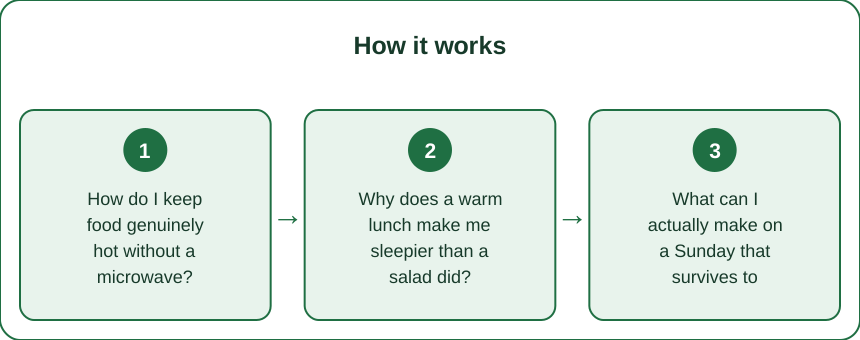
How do I keep food genuinely hot without a microwave?
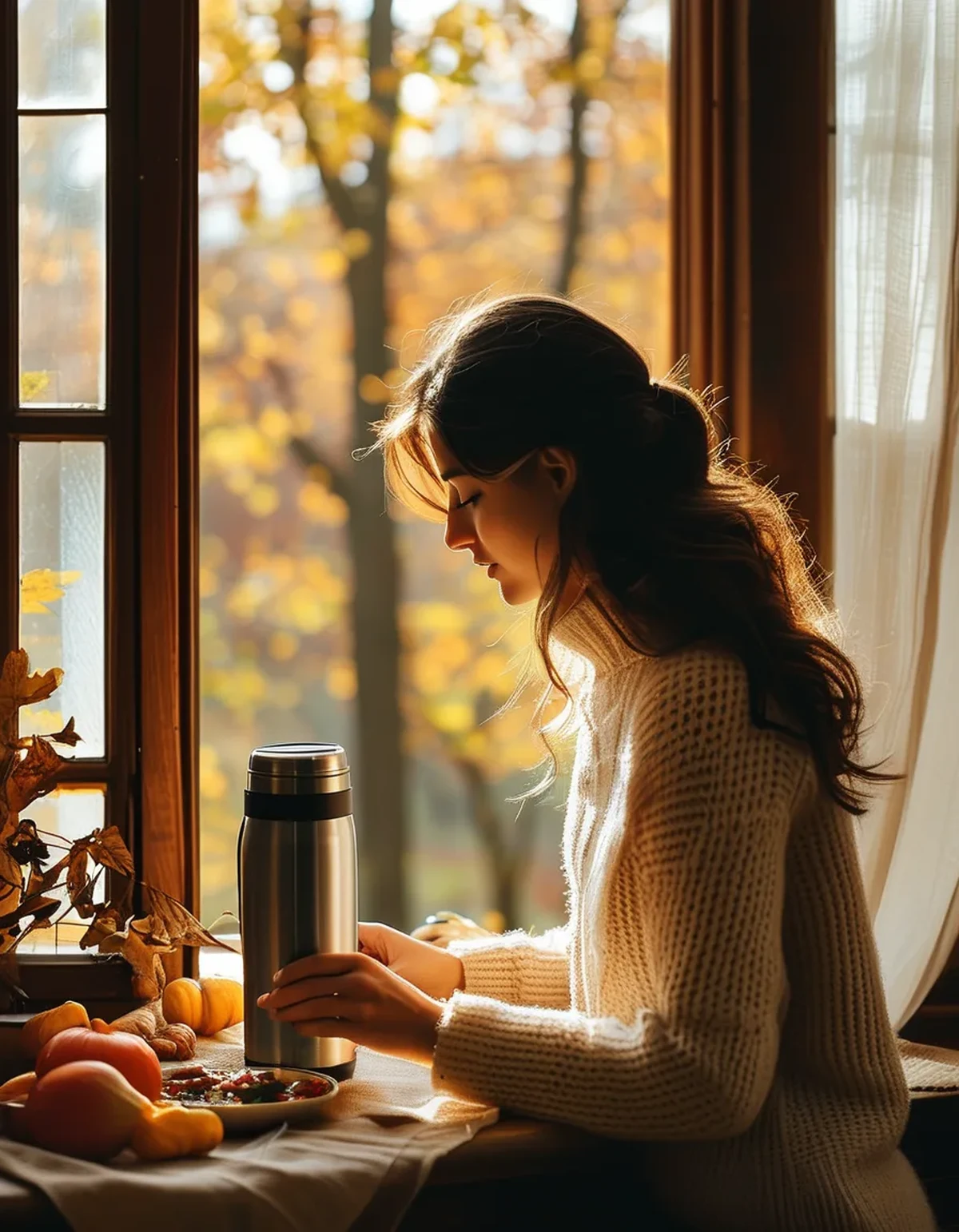
A vacuum flask, used properly. The difference between a flask used properly and one used casually is roughly four hours of heat retention.
Preheat the flask. This is the step almost everyone skips and it is the most important one. Fill the flask with boiling water, put the lid on, and leave it for five minutes while you heat the food. Pour it out immediately before filling. An unheated flask spends the first hour bringing its own steel up to temperature, using your food’s heat to do it.
Pack the food hot, not warm. Food should go in at above 74°C — properly steaming, not comfortable to eat. A flask does not heat anything; it slows cooling. Food packed at 60°C will be lukewarm by noon regardless of the flask.
Fill it completely. Air space is where heat goes. A flask filled two-thirds cools substantially faster than one filled to the top. If you have less food than the flask holds, use a smaller flask.
Do not open it before you eat. Every opening resets the clock significantly.
Choose the right food. Anything with high water content and a thick consistency holds heat best — stews, thick soups, chilli, dal, curry, congee. Foods with a lot of surface area and little liquid — pasta with sauce on top, rice with a dry topping — cool much faster.
A good vacuum flask preheated and filled with genuinely hot thick food will be properly hot at six hours. The same flask unheated, three-quarters filled with warm food, will be tepid at three.
Why does a warm lunch make me sleepier than a salad did?
Partly composition, partly timing, and partly the season.
The post-lunch dip is real and it is partly circadian. There is a genuine trough in alertness in the early afternoon that exists independently of what you eat — it shows up even in people who skip lunch entirely. So some of the 2pm slump was always going to happen.
Meal composition modulates how deep it gets. Larger meals produce a bigger dip than smaller ones, and meals high in rapidly-digested carbohydrate produce a bigger dip than balanced ones. Warm lunches tend to be carbohydrate-heavier than summer salads — rice, pasta, bread, potato — which is a real change from what you were eating in July.
Seasonal light matters too. Lower light levels in autumn afternoons contribute independently to reduced alertness, and offices tend to be dimmer than the summer equivalent.
Practical adjustments that actually help:
- Keep the carbohydrate portion moderate and make sure there is meaningful protein. A soup that is entirely vegetables and noodles will hit harder than one with beans or chicken in it.
- Add fibre. Slower gastric emptying blunts the glucose response and flattens the dip.
- Eat slightly less at lunch and add an afternoon snack. Splitting the meal is one of the most reliable fixes.
- Go outside for five minutes after eating. Light exposure and a short walk both directly counteract the dip, and this is more effective than another coffee.
- Move your coffee later. Caffeine at 2pm rather than 11am aligns it with the trough. Just keep it early enough not to affect sleep.
What can I actually make on a Sunday that survives to Thursday?
Not everything keeps equally well, and the difference is mostly about moisture and starch.
Excellent at four days: chilli, dal, bean stews, curry, braised meat dishes, thick vegetable soups. These improve over the first two days as flavours develop, and their texture is not damaged by reheating.
Good at two to three days: grain bowls where the components are stored separately, roasted vegetables, frittata, thick lentil soup.
Poor beyond two days: anything with pasta already in the sauce, rice-based dishes stored at the wrong temperature, cream-based soups, and anything with a crisp element.
Two safety points that matter more with warm food than cold:
Cool it fast before refrigerating. Food should go from cooking temperature to fridge temperature quickly — divide into shallow containers rather than cooling a large pot, and get it in the fridge within two hours. Slow cooling in the danger zone is the main risk with batch cooking.
Rice needs particular care. Cooked rice should be cooled and refrigerated quickly and reheated thoroughly, because Bacillus cereus spores survive cooking and can produce toxin at room temperature. Rice left out to cool for hours is the classic problem case.
Reheat to properly steaming, not just warm, before it goes in the flask. This does double duty — food safety, and it is the temperature you need for the flask to work anyway.
A practical Sunday: make one large pot of something from the four-day list, portion it into containers immediately, and use two of them Monday and Tuesday. Freeze the rest, which resets the clock entirely and gives you Thursday and Friday covered.
What about the days I have no time at all?
This is where most warm-lunch plans fail, and it is worth building for rather than hoping against.
Keep a shelf of desk-drawer components. Instant miso or stock sachets, a jar of good chilli oil, instant oats, a tin of beans, a packet of microwaveable grains if there is a microwave. These are not a lunch; they are what turns half a lunch into a lunch.
The flask of boiling water trick. If you have zero prep time, fill a preheated flask with boiling water in the morning. At lunchtime you can make instant noodles, couscous, oats, or a stock-based soup from dry components in about four minutes with no kitchen at all.
Freeze in single portions from the start. A freezer of individual portions means a no-time morning takes fifteen seconds — take one out, reheat, flask. A freezer of large containers means you cannot use it on a busy morning at all.
Accept the bought lunch on some days and plan for it. A system that requires five out of five days collapses the first week something goes wrong. Three out of five is a system that survives autumn.
Keep the same thing several days running. Variety is the enemy of adherence in food prep, and the effort of planning five different lunches is where most people stop. Two dishes a week, alternating, is dramatically easier and almost nobody actually minds.
FAQ: Warm Desk Lunch Questions, Answered
Is a food flask actually safe for holding food for six hours?
Yes, provided the food goes in above 74°C and the flask is preheated — the point is keeping it above the temperature range where bacteria multiply. A flask that has cooled to lukewarm has spent time in that range, which is why the preheat and the packing temperature matter for safety and not just for enjoyment.
Can I put a cold lunch in the same flask and take it out at noon?
Vacuum flasks work in both directions, so yes — preheating becomes prechilling, with ice water for five minutes. This is genuinely useful in the transition weeks when you want something cold on the warm days.
How do I stop everything tasting the same by Wednesday?
Change the finish rather than the base. The same bean stew with chilli oil and yoghurt on Monday, lemon and herbs on Tuesday, and a spoon of pesto on Wednesday reads as three different lunches. Storing the finishing elements separately at your desk costs nothing and solves most of the monotony problem.
TL;DR:
- Preheat the flask with boiling water for five minutes and fill it to the top — this is worth about four hours of heat retention
- Pack food above 74°C; a flask slows cooling, it does not heat anything
- Keep carbohydrate moderate and add protein and fibre to flatten the post-lunch dip
- Chilli, dal, bean stews and thick soups genuinely last four days; pasta in sauce does not last two
- Cool batch-cooked food fast, be careful with rice, and freeze in single portions so busy mornings still work
The warm lunch is not more effort than the salad once the system is set up. It is just a different system, and most of it comes down to five minutes with a kettle before you leave the house.
Keep Reading
This article is for general informational purposes only and is not medical advice. Always consult a qualified health professional for guidance specific to you.