How Much Protein Should Actually Be in Your Desk Lunch? Real Questions, Real Numbers
Quick Answer: Most desk lunches contain 10 to 15 grams of protein when they should contain 25 to 35. That shortfall is the single most common reason people feel hungry, foggy and snack-seeking by mid-afternoon. Fixing it usually means adding one dense protein source rather than redesigning the whole meal.
The 3pm crash gets blamed on blood sugar, on carbs, on sitting too long, on the lunch being too big. Sometimes those are right.
But the most consistent pattern in a typical packed lunch is not too many carbohydrates — it is not enough protein. And unlike most nutrition advice, this one has a specific number you can check tonight.

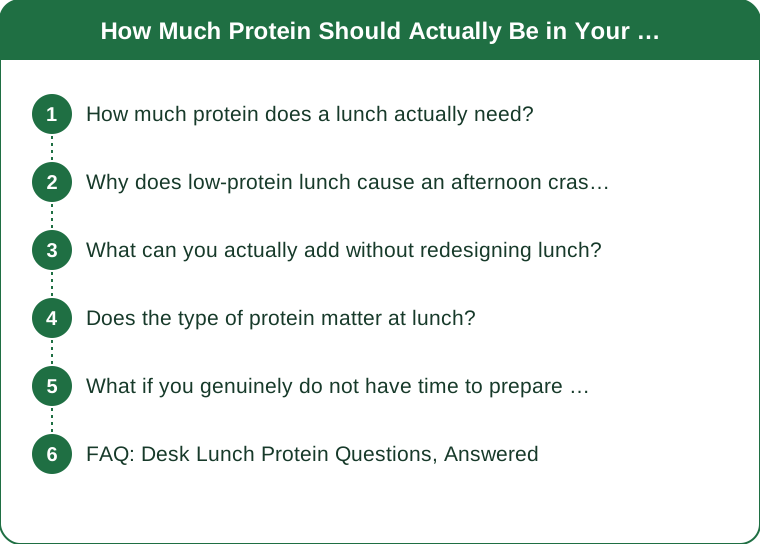
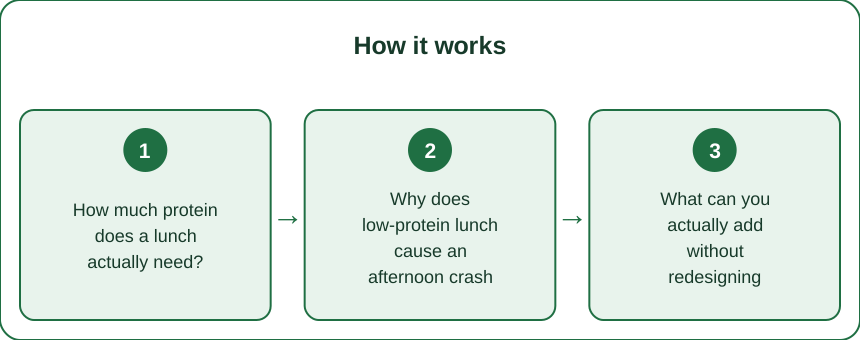
How much protein does a lunch actually need?
Start from the daily figure and divide it sensibly.
A reasonable daily target for an adult who exercises is 1.2 to 1.6 grams per kilogram of body weight. For a 65kg person that is roughly 78 to 104 grams a day. For a 80kg person, 96 to 128.
Protein is used best when it is distributed rather than concentrated, and research on muscle protein synthesis suggests a per-meal threshold of around 25 to 30 grams for most adults to get a full response. Below that, some of the benefit is left on the table regardless of your daily total.
So for three meals a day, lunch should be carrying 25 to 35 grams.
Now audit a typical packed lunch. A chicken salad sandwich has perhaps 15 to 18g. A grain bowl with roasted vegetables and a drizzle of tahini has maybe 8. A soup and a bread roll, often under 10. Leftover pasta with vegetables, around 12.
Most people are running a 10 to 20 gram deficit at lunch, every working day, and making it up — or not — in the evening. That is the whole problem in one number.
Why does low-protein lunch cause an afternoon crash specifically?
Three mechanisms, all of them modest on their own and significant combined.
Satiety duration. Protein is the most satiating macronutrient per calorie and it slows gastric emptying. A carbohydrate-dominant lunch empties from the stomach faster, so hunger signals return sooner. That is why a 600 calorie low-protein lunch can leave you hungrier at 3pm than a 450 calorie high-protein one.
Blood sugar curve. Protein and fat blunt the glucose response to the carbohydrate in the same meal. Without enough protein, the rise is sharper and the subsequent fall is steeper, which produces the familiar mid-afternoon flatness.
Amino acid availability. Less direct but worth mentioning — tyrosine, a precursor to dopamine and noradrenaline, comes from dietary protein. A meal low in protein and high in carbohydrate shifts the amino acid balance in a direction that favours serotonin, which is associated with feeling more relaxed and less alert. This is a real effect, though it is smaller than the internet suggests.
The practical version: the 3pm snack drawer visit is not a willpower failure. It is your body correctly identifying that lunch was insufficient.
What can you actually add without redesigning lunch?
The efficient approach is to add one dense item rather than restructure the meal. Protein content per typical serving:
- Greek yogurt, 170g pot — 15 to 18g
- Cottage cheese, 100g — 11g
- Two hard-boiled eggs — 12g
- Tin of tuna, drained, 100g — 25g
- Rotisserie chicken, 100g — 30g
- Edamame, 100g shelled — 11g
- Tofu, firm, 100g — 15g
- Tempeh, 100g — 19g
- Chickpeas, 150g — 11g
- Beef jerky, 30g — 10g
- Protein shake — 20 to 25g
- Roasted chickpeas or edamame snack pack — 8 to 12g
The most practical office additions are the ones that require no preparation and no refrigeration risk: a tin of tuna, a protein shake, or a pot of Greek yogurt kept in the office fridge.
A simple rule that avoids arithmetic entirely: make protein the first thing you pack, not the last. Decide on the protein, then build the rest of the lunch around it. Most low-protein lunches happen because the protein was an afterthought added to a base of grains and vegetables that was already filling the container.

Does the type of protein matter at lunch?
Somewhat, and in ways that matter more for a packed lunch than for a meal at home.
Animal proteins are more complete and more concentrated, which means hitting 30g takes less volume. This matters when lunch has to fit in a container and be eaten in fifteen minutes at a desk.
Plant proteins need combining and more volume. Getting 30g from plants at lunch is entirely possible — tempeh, tofu, lentils, edamame, seitan — but it usually means a larger portion, and lentil-and-grain based lunches tend to land around 15 to 20g rather than 30 unless deliberately built. Adding a plant protein powder to a soup or smoothie is the low-effort fix.
Food safety is a genuine constraint that changes what is practical. Cooked chicken, fish and eggs sitting at desk temperature from 8am to 1pm are in the risk zone above 4°C for longer than the recommended four-hour limit. An ice pack in the lunch bag solves this, and it matters most in late summer — offices that were warm in August become the reason a lunch tastes off, and the risk drops as the weather cools.
Texture and reheating are the quiet limiter. Chicken breast reheats poorly and dries out, which is why so many people abandon it. Thigh meat, tinned fish, tofu and legumes all handle cold or reheated service far better.
What if you genuinely do not have time to prepare lunch?
This is the most common reason lunches end up low in protein, and it has practical answers that do not involve meal prep Sunday.
Keep a protein source at the office permanently. Tinned tuna, a jar of nut butter, protein powder, or beef jerky in a desk drawer. Then whatever you buy or grab can be topped up to target. This solves the problem structurally rather than requiring you to be organised every morning.
Buy the protein, bring the rest. If you are buying lunch anyway, buying a chicken or salmon portion and adding your own bread, salad or leftovers is usually cheaper than a full bought lunch and lands the protein target easily.
Use the store cupboard. Tins of beans, lentils and fish need no preparation and keep indefinitely. A tin of chickpeas added to a supermarket salad turns an 8g lunch into a 19g one for under a dollar.
Batch one thing, not everything. Meal prep fails because people try to build five complete meals. Cooking one tray of chicken thighs or a batch of hard-boiled eggs on Sunday takes twenty minutes and is the only prep that actually matters.
The back-to-school timing is relevant here: early September is when morning routines get compressed for anyone with school-age children, and lunch preparation is the first thing to be dropped. Setting up the desk-drawer backup before the schedule tightens is considerably easier than fixing it in October.
FAQ: Desk Lunch Protein Questions, Answered
Can I just eat more protein at dinner instead?
You will hit your daily total, which matters most. But you will still be hungry at 3pm, and the per-meal distribution does appear to matter modestly for muscle protein synthesis. If afternoon energy is your complaint, the timing is the point.
Is too much protein at lunch a problem?
For healthy kidneys, no. Very large single doses — over 50g — do not add much benefit, and a heavy meal can make you sluggish for reasons unrelated to protein. The 25 to 35g range is where the benefit sits without the downside.
Do protein bars count?
Check the label — many contain 8 to 12g, which is a snack rather than a meal component. Bars above 20g exist and are useful. Bars marketed as protein bars with 10g and 25g of sugar are candy with a claim.
Will more protein help with the 3pm sugar craving?
Often, yes, and it is one of the more reliable interventions. Cravings that follow a low-protein lunch by two to three hours usually diminish substantially once lunch protein goes above 25g.
What about vegetarians and vegans?
The target is the same and reaching it takes deliberate construction. Tempeh, tofu, seitan, lentils and edamame are the dense options; combining two of them in one lunch is usually what it takes. A plant protein powder in a soup or smoothie is the simplest fix.
This is general information, not medical advice. If you have kidney disease or any condition affecting protein metabolism, discuss targets with your clinician.
TL;DR:
- Aim for 25 to 35g of protein at lunch; most packed lunches deliver 10 to 15.
- The 3pm crash and snack-drawer visit are usually a protein shortfall, not a willpower problem.
- Add one dense item — tinned fish, Greek yogurt, eggs, tempeh — rather than redesigning the meal.
- Keep a shelf-stable protein source at your desk so a rushed morning does not become a bad afternoon.
Protein at lunch is one of the few nutrition changes with a same-day payoff. You do not have to wait weeks to find out whether it worked — you find out at 3pm.
Keep Reading
This article is for general informational purposes only and is not medical advice. Always consult a qualified health professional for guidance specific to you.