Desk Lunch: Every Real Question People Actually Ask, Answered Directly
Quick Answer: The most common desk lunch problems — feeling unsatisfied despite eating enough, smell complaints from coworkers, and food safety at room temperature — all have specific, practical fixes rooted in eating away from screens, choosing lower-odor foods, and using proper insulated storage, not just ‘eat something healthier.’
Desk lunch advice tends to be generic meal-prep content. These are the specific, practical questions people actually run into.

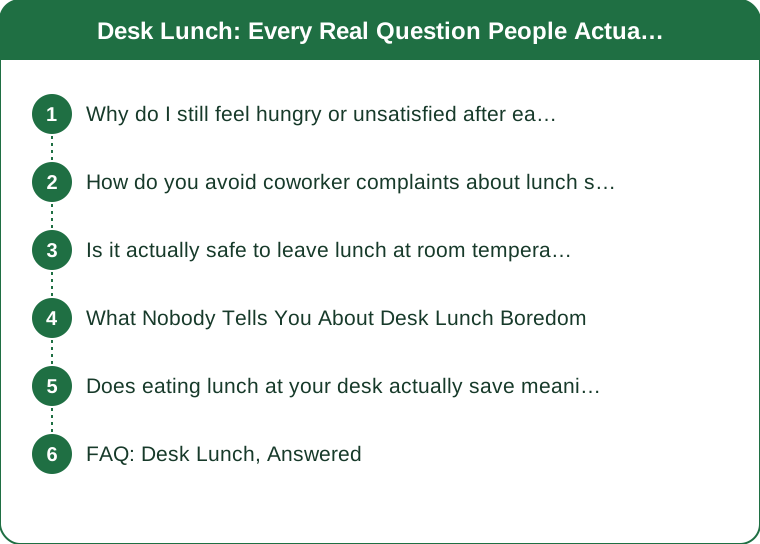
Why do I still feel hungry or unsatisfied after eating a full desk lunch?
Eating while working or scrolling reduces conscious awareness of fullness cues, since attention split between food and screen work measurably lowers how satisfied people feel from the same meal compared to focused eating. Taking even 5-10 minutes away from your screen specifically to eat tends to improve satisfaction with the same amount of food.
How do you avoid coworker complaints about lunch smell in a shared office?
Choosing lower-odor foods for office days specifically (avoiding strong fish, certain curries, or heavily garlic-forward dishes) and reheating food in a break room rather than at your desk when possible addresses most smell complaints. Some offices also have unwritten norms around this worth being aware of beyond the food choice itself.
Is it actually safe to leave lunch at room temperature until midday?
Perishable food left above 40°F for more than two hours enters a food safety risk window, so a desk lunch prepared in the morning and eaten several hours later without proper insulation genuinely needs a cooler bag with an ice pack, not just a bag on your desk. This is a real food safety consideration, not an overcautious suggestion.

What Nobody Tells You About Desk Lunch Boredom
Boredom with desk lunch options usually stems from repeating the exact same 2-3 meals rather than an actual lack of good options — building a rotating list of just 5-6 go-to meals, rather than trying to plan something completely new each day, tends to solve boredom without adding meal-planning burden.
Does eating lunch at your desk actually save meaningful time compared to a break?
Often less than people assume — the time saved by not physically leaving your desk is frequently offset by reduced afternoon focus and energy from skipping an actual mental break, meaning a short walk-and-eat break can be more net-productive than an at-desk lunch that saves 10-15 minutes but leaves you less focused afterward.
FAQ: Desk Lunch, Answered
What’s a realistic way to build in a break without leaving the building?
Even 10 minutes eating away from your desk in a break room or outdoor space provides a meaningful mental reset compared to eating at your workstation.
Are meal prep containers worth the investment for desk lunches?
Yes, particularly insulated ones — they solve both the food safety and food quality concerns that loose bagged lunches often run into.
How far in advance should desk lunches be prepped?
Most people find prepping 2-3 days at a time balances freshness with actually saving time, rather than daily prep or a full week at once.
TL;DR:
- Eating away from your screen for even a few minutes improves fullness satisfaction
- Choosing lower-odor foods and reheating away from your desk avoids most smell issues
- Perishable lunches need proper insulation for food safety, not just a bag on your desk
- A short rotating list of go-to meals solves boredom better than daily new planning
If desk lunch has felt like a chore, start with the simplest fix — eating away from your screen for just ten minutes — before overhauling anything else.
Keep Reading
This article is for general informational purposes only and is not medical advice. Always consult a qualified health professional for guidance specific to you.