How Long Should a Lunch Break Actually Be to Feel Like One
Quick Answer: The threshold for a break that actually restores you is shorter than most people assume - roughly 15 to 20 minutes of genuine detachment does most of the work, and detachment matters more than duration. A 45-minute lunch spent answering email restores less than 15 minutes away from the screen. The three things that make the difference are leaving the workspace, putting the phone somewhere else, and not making a decision about work during it.
Most people believe they do not have time for a real lunch break. Most people are also wrong about how long one has to be.

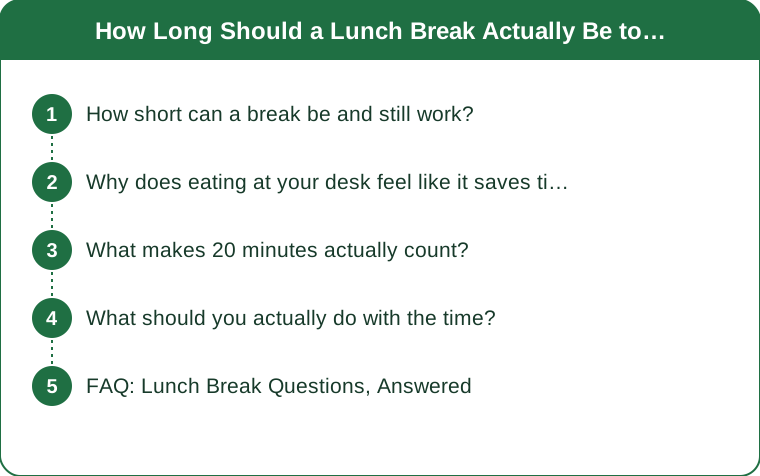
How short can a break be and still work?
Shorter than the hour everyone imagines they need, which is the useful news.
Around 15 to 20 minutes of true detachment covers most of the benefit. Research on workday recovery consistently finds that the quality of a break - specifically whether you mentally disengage from work - predicts restoration better than how long it lasts. A short, genuinely detached break outperforms a long, half-attentive one.
Detachment is the active ingredient. If you are eating while reading a work thread, your attention never left, and the break barely registers physiologically or cognitively. The clock keeps running; the recovery does not start.
Longer helps, but with diminishing returns. Thirty to 45 minutes is better than 20 if you can get it - more so if it includes walking outside. Beyond that, the extra time mostly adds pleasantness rather than restoration.
Consistency beats length. Twenty minutes every day beats an hour twice a week by a wide margin, because the afternoon slump you are trying to prevent arrives daily.
Why does eating at your desk feel like it saves time?
Because it does save time in the narrowest possible sense, and costs it everywhere else.
You gain the minutes and lose the afternoon. Desk lunches reliably precede the mid-afternoon attention drop. The half hour you saved gets spent, with interest, on slower work between 2 and 4pm.
You eat more without noticing. Eating while working consistently produces less awareness of fullness and more snacking later. It is not a discipline issue - attention directed elsewhere genuinely reduces the satiety signal.
The desk stops being a place you can leave. When lunch happens at the desk, there is no point in the day when you physically separate from work. That single physical separation is doing more work than the food is.
And there is a social cost. Lunch is where the informal information in a workplace moves - context, plans, the things nobody puts in writing. Skipping it every day is a slow, invisible cost that never shows up as a reason to change.
Is it ever fine to eat at the desk?
Yes - occasionally, on genuinely busy days, is completely fine. The problem is the default, not the exception. If the desk lunch is what happens when nothing has gone wrong, that is the thing worth changing.

What makes 20 minutes actually count?
Three conditions. Miss any one and the break degrades sharply.
Do you have to physically leave?
Yes, and this is the non-negotiable one. Changing your physical location is what signals the shift - a different room, a lobby, a bench, outdoors if the weather allows. Staying at the desk with the laptop closed does not achieve it, because the environmental cues are unchanged.
Does the phone matter that much?
More than people want to hear. Scrolling delivers stimulation, not restoration - you finish just as depleted, having spent the entire break in the same attentional mode as work. Face down, in a bag, or in a drawer. If you want input, a few pages of something unrelated works far better.
What about work thoughts you cannot switch off?
Write the thought down and leave it. The point is not to have an empty mind - it is to stop actively solving. A notes app entry takes 10 seconds and reliably ends the loop, because the brain stops rehearsing something once it is recorded.
One addition, worth more than it sounds: going outside. Daylight exposure in the middle of the day supports the circadian signal that governs afternoon alertness, and late August still offers plenty of it. Twenty minutes outdoors beats 20 minutes in a break room by a noticeable margin.
What should you actually do with the time?
Should you walk or sit?
Either works, and they do different things. A walk raises alertness and helps digestion; sitting still restores attention more directly. If you had a morning of meetings, walk. If you had a morning of concentrated work, sit. Match the break to what depleted you.
Does eating with people count as detachment?
Yes, provided the conversation is not about work. Social contact is one of the more effective recovery activities available in a workday. A lunch spent discussing the project you just left is a meeting with food.
Is a nap a better use of the time?
For some people, meaningfully so. A 10 to 20 minute nap improves afternoon alertness without the grogginess longer naps produce. It only works if you can actually fall asleep quickly and if your workplace makes it possible - which for most people it does not, making the walk the more practical option.
What about the day the break is impossible?
Take five minutes. Genuinely - a five-minute walk to the far end of the building and back, phone left behind, delivers more than nothing by a large margin. The all-or-nothing framing is why most people take no break at all, and it is the belief worth abandoning first.
FAQ: Lunch Break Questions, Answered
Will taking a real break make me look less committed?
In most workplaces the opposite is true over time, because afternoon output is visible and a mid-afternoon collapse is also visible. If your specific workplace genuinely penalizes a 20-minute lunch, that is useful information about the workplace rather than a scheduling problem.
What is the best time to take it?
Roughly four to five hours after you started, which for most people falls between 12 and 1. Pushing lunch to 2pm means running on empty through the exact window when concentration is most needed, and then eating too close to the end of the day.
Does what I eat change how the break feels?
Yes. A lunch heavy in refined carbohydrates with little protein contributes to the afternoon dip. Protein plus fiber plus something with water content - the standard combination - keeps energy steadier. But the break structure matters more than the plate; a mediocre lunch eaten away from the desk beats a perfect one eaten in front of a monitor.
How do I make it stick past the first week?
Attach it to something already fixed - a calendar block, a walking partner, or a standing daily task in another part of the building. Habits that depend on remembering fail; habits attached to an existing anchor survive.
This is general information, not medical advice.
TL;DR:
- 15 to 20 minutes of genuine detachment does most of the restorative work; length matters far less than disengagement.
- Three conditions make it count: physically leave the workspace, put the phone away, and stop actively solving work problems.
- Desk lunches buy minutes and cost the afternoon - the slump between 2 and 4pm is largely a break-quality problem.
- Going outside beats a break room, and consistency every day beats a long break twice a week.
The reason this stays unsolved for so many people is the belief that a real break requires an hour nobody has. It does not. It requires 20 minutes, somewhere that is not your desk, without your phone - which almost everyone can find, and almost nobody takes.
Keep Reading
This article is for general informational purposes only and is not medical advice. Always consult a qualified health professional for guidance specific to you.