Warm Desk Lunch Without a Microwave: Your Questions, Answered
Quick Answer: A good vacuum food thermos, preheated with boiling water for 5-10 minutes and filled with food at a genuine simmer, will hold food above the food-safe 140F threshold for around 4-6 hours. Preheating is not optional - an unpreheated thermos loses a large share of the food’s heat immediately warming its own steel walls. Wide-mouth containers work far better than narrow ones for anything you have to eat with a fork.
The questions below come up constantly once the weather turns, in roughly this order.
How does a thermos actually keep food safe, and for how long?
The food safety framework is the danger zone: bacteria multiply fastest between 40F and 140F. Food held above 140F is in the safe range; food that drifts below it and stays there for over two hours is in questionable territory.
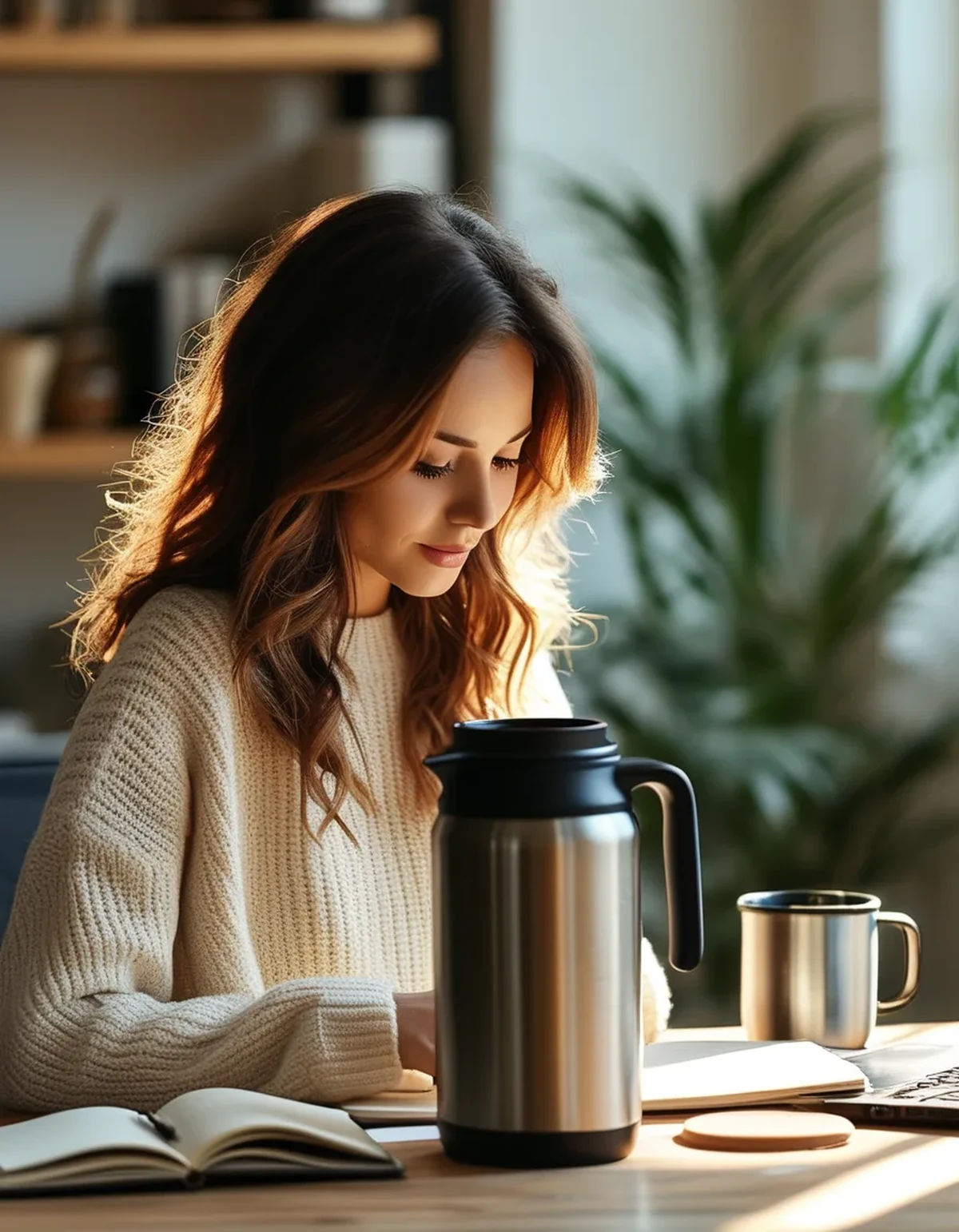
A quality vacuum-insulated food jar, properly used, holds food above 140F for roughly 4-6 hours. That comfortably covers a 7:30 am fill and a noon lunch.
The three things that determine whether you actually get that:
1. Preheating. Fill the empty thermos with boiling water, cap it, and let it stand 5-10 minutes. Dump it right before adding food. Skipping this is the single biggest cause of lukewarm lunches - a cold steel interior absorbs a substantial share of your food’s heat energy just warming itself up.
2. Starting temperature. The food must go in at a genuine simmer, not merely warm. A thermos does not heat anything; it only slows loss. Food that goes in at 160F starts much closer to the danger zone than food that goes in at 200F.
3. Fullness. A full container holds heat far better than a half-full one, because air space is where heat goes. If you want a smaller portion, use a smaller thermos rather than under-filling a large one.
And do not open it early. Every opening vents the accumulated heat and resets the clock meaningfully.
What food actually travels well, and what falls apart?
Works extremely well:
- Soups, stews, chilis, curries. Liquid holds heat better than solids by a wide margin, and these improve on standing.
- Grain bowls with a hot base - rice, farro, barley - topped with roasted vegetables and a protein.
- Pasta with a sauce that has body. Slightly undercook the pasta; it continues to soften in the thermos.
- Baked beans, lentil dishes, dal. Heat retention and flavor both improve over four hours.
- Oatmeal and congee for an early or late shift.
Works with a caveat:
- Anything with crisp elements. Pack the crisp part separately - croutons, seeds, fried shallots, tortilla chips in a small bag, added at the desk.
- Leafy greens. Add fresh at the desk rather than cooking them into the thermos, where they go grey and slimy.
- Fish. Fine texturally, but consider your colleagues.
Does not work:
- Anything fried. Steam is the enemy of crisp, and a sealed thermos is a steam chamber.
- Delicate pasta shapes, which turn to paste over four hours.
- Dairy-heavy cream sauces, which can separate on long holding.
- Cooked eggs, which turn rubbery.
A trick that improves almost everything: pack an acid separately - a squeeze of lemon, a splash of vinegar, a spoon of pickled onion - and add it at the desk. Four hours in a sealed container dulls flavor, and acid brings it right back.

Why does food taste worse after four hours in a thermos?
Two separate effects, and both are fixable.
Aromatics dissipate. A sealed container traps volatile compounds in the headspace, and when you open it, most of the aroma leaves in the first few seconds. Since a large share of flavor perception is olfactory, the food genuinely tastes flatter than it did on the stove.
Continued cooking. Held at 150F+ for hours, food keeps cooking slowly. Vegetables soften past where you left them, herbs go muted and grey, and textures converge toward uniform softness.
How to compensate when packing:
- Under-season slightly on the aromatics, over-season slightly on the salt. Salt perception drops as food cools from very hot toward warm.
- Undercook vegetables by about 20%. They will arrive where you wanted them.
- Hold back fresh herbs entirely, packing them separately in a small container. Fresh cilantro or parsley added at the desk transforms a four-hour-old curry.
- Pack a flavor kit - a small jar with chili crisp, hot sauce, lemon wedges, flaky salt, or a pickle. This does more for desk lunch satisfaction than any recipe upgrade.
- Add texture at the desk. Toasted nuts, seeds, or crisp fried onions restore the contrast that hours of steam removed.
The general principle: pack the durable things, carry the fragile things separately.
How do you fit this into a morning that is already tight?
The honest answer is that you do almost none of it in the morning.
The night-before method (5 minutes at night, 3 in the morning): cook or portion the food the night before and refrigerate. In the morning, reheat to a full simmer on the stove or in the microwave while the thermos preheats with boiling water. Fill, seal, go.
The batch method (one 45-minute session per week): make one large pot of soup, chili, or curry on Sunday, portion into containers, and reheat one each morning. This is where the thermos approach becomes genuinely low-effort, because the daily work collapses to reheating.
The overnight-hot method: for a soup you want at lunch, some people fill the thermos at 10 pm with boiling-hot food and refrigerate the sealed thermos. This is not recommended - it puts food in the danger zone as it slowly cools. Reheat in the morning instead.
The kettle shortcut: for anything that rehydrates - instant noodles, couscous, dried soup base, quick oats - put the dry ingredients in the preheated thermos and add boiling water at your desk from an office kettle. Zero morning cooking, and the food is at full temperature when you eat it.
A realistic weekly rhythm: two days of batch-cooked reheats, one day of the kettle shortcut, one day of leftovers from dinner, one day of buying lunch. Nobody sustains five days of packed hot lunches, and planning for four is how the habit survives past November.
FAQ: Thermos Lunch Questions, Answered
How do I clean it properly?
Hot soapy water and a bottle brush immediately after use. Never a dishwasher unless the manufacturer explicitly allows it - dishwasher heat can compromise the vacuum seal on some models. For lingering smells, fill with hot water and a tablespoon of baking soda overnight.
Wide mouth or narrow?
Wide mouth, for anything you eat with a fork or spoon. Narrow-mouth bottles are designed for drinks and are miserable to eat from and clean. Look for one that fits a standard spoon comfortably.
How do I know if my thermos is any good?
Test it: preheat it, fill it with boiling water, seal it, and check the temperature five hours later with a kitchen thermometer. A good vacuum flask should still be well above 140F. If it is lukewarm, the vacuum has failed and it will not keep food safe.
Is it safe to eat if it is only warm rather than hot at noon?
If it is below 140F and has been for an unknown period, the two-hour rule applies. Practically, if it went in at a full simmer in a preheated quality thermos and it is noon, you are fine. If it is barely warm, something failed - and the safe call is not to eat it. This is general information, not medical advice.
What about cold lunches in winter?
They are fine and safe, they are just less satisfying when it is dark at 5 pm. A hot drink alongside a cold lunch covers a surprising amount of that gap if the thermos routine is not for you.
TL;DR:
- Preheat the thermos with boiling water for 5-10 minutes. This is the step that determines everything.
- Food goes in at a full simmer, in a full container, and stays safe above 140F for about 4-6 hours.
- Soups, stews, and grain bowls travel well. Fried food, delicate pasta, and cooked eggs do not.
- Pack acid, fresh herbs, and crunch separately and add them at the desk - it fixes the flatness.
The cold months are when desk lunch either becomes the best fifteen minutes of your workday or the thing you resent. A good thermos and a Sunday pot of something decide which.
Keep Reading
This article is for general informational purposes only and is not medical advice. Always consult a qualified health professional for guidance specific to you.